The Story
Patricia knew the assignment mattered the moment she read the client’s message.
We’d like you to write the About page for our new creative studio.
The company was small but growing.
The founders had built the studio from freelance work, late nights, and referrals.
Patricia liked that.
It reminded her of the kind of career she wanted to build for herself.
The brief said:
Warm.
Professional.
Personal.
Not corporate.
Patricia read the last line twice.
Not corporate.
“Good,” she said.
Draft looked over the edge of the laptop.
“You sound relieved.”
“I know how to write corporate.”
“That did not sound like a compliment.”
“It was not.”
Patricia began with the founders’ story.
She wrote about their first project, how they had worked from a dining table, and how one happy client had introduced them to another.
The first draft sounded simple.
Human.
A little imperfect in the way real people were imperfect.
Patricia liked it.
Then she imagined the client reading it.
Would they think it sounded professional enough?
Would they think the vocabulary was too plain?
Would someone like Scribe rewrite half of it?
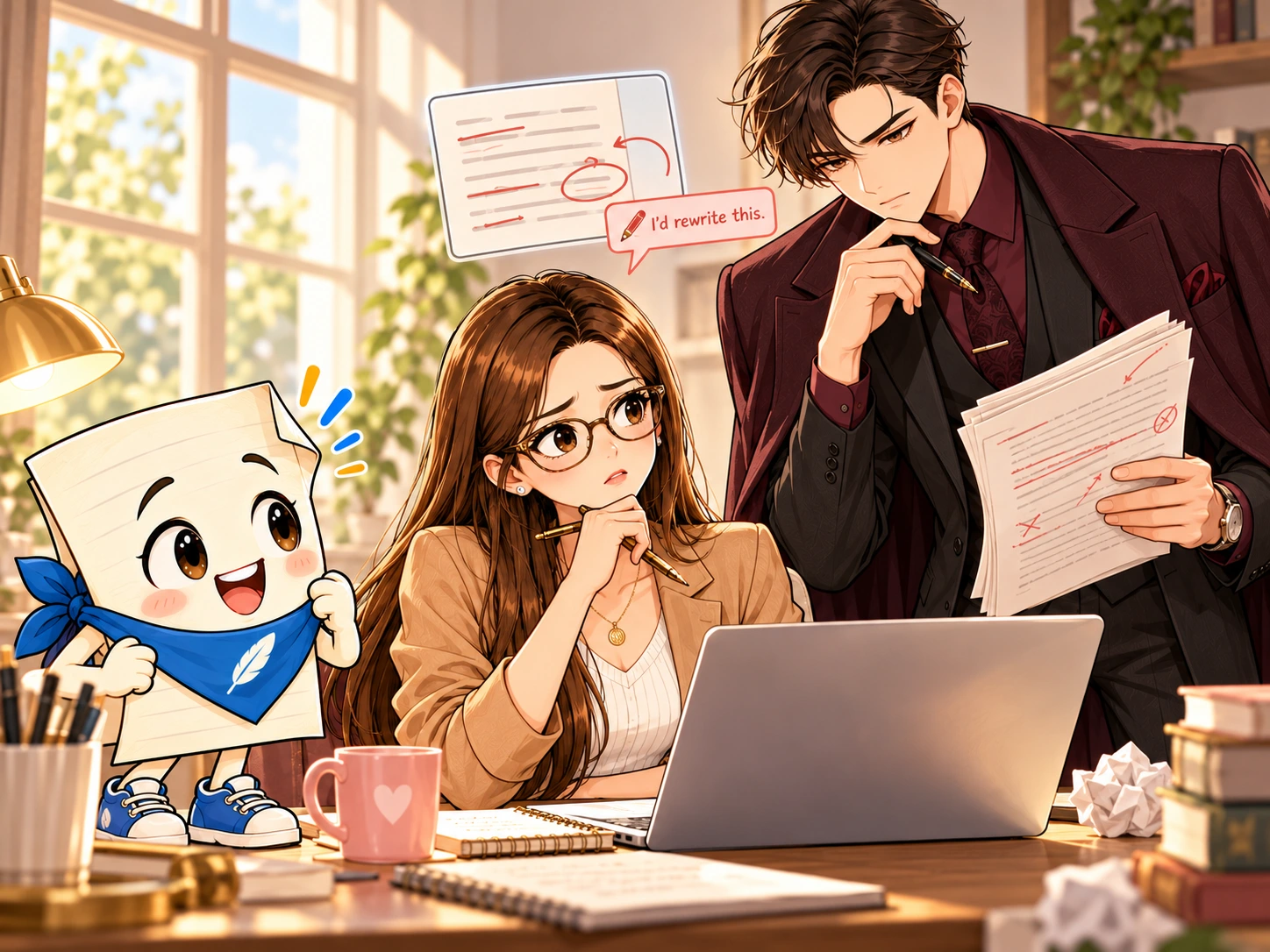
That last thought was enough to make her reach for another tool.
She copied the opening paragraph into an AI rewriting window.
Her instruction was short:
Make this more professional and polished.
The new version appeared almost instantly.
Patricia read it.
The paragraph was smooth.
Every sentence was balanced.
The vocabulary sounded expensive.
Draft leaned closer.
“What do you think?”
Patricia kept reading.
“I think it sounds good.”
Draft waited.
Patricia knew that look.
She sighed.
“You are going to ask whether it sounds like me.”
“I was.”
Patricia read the original.
Then the rewrite.
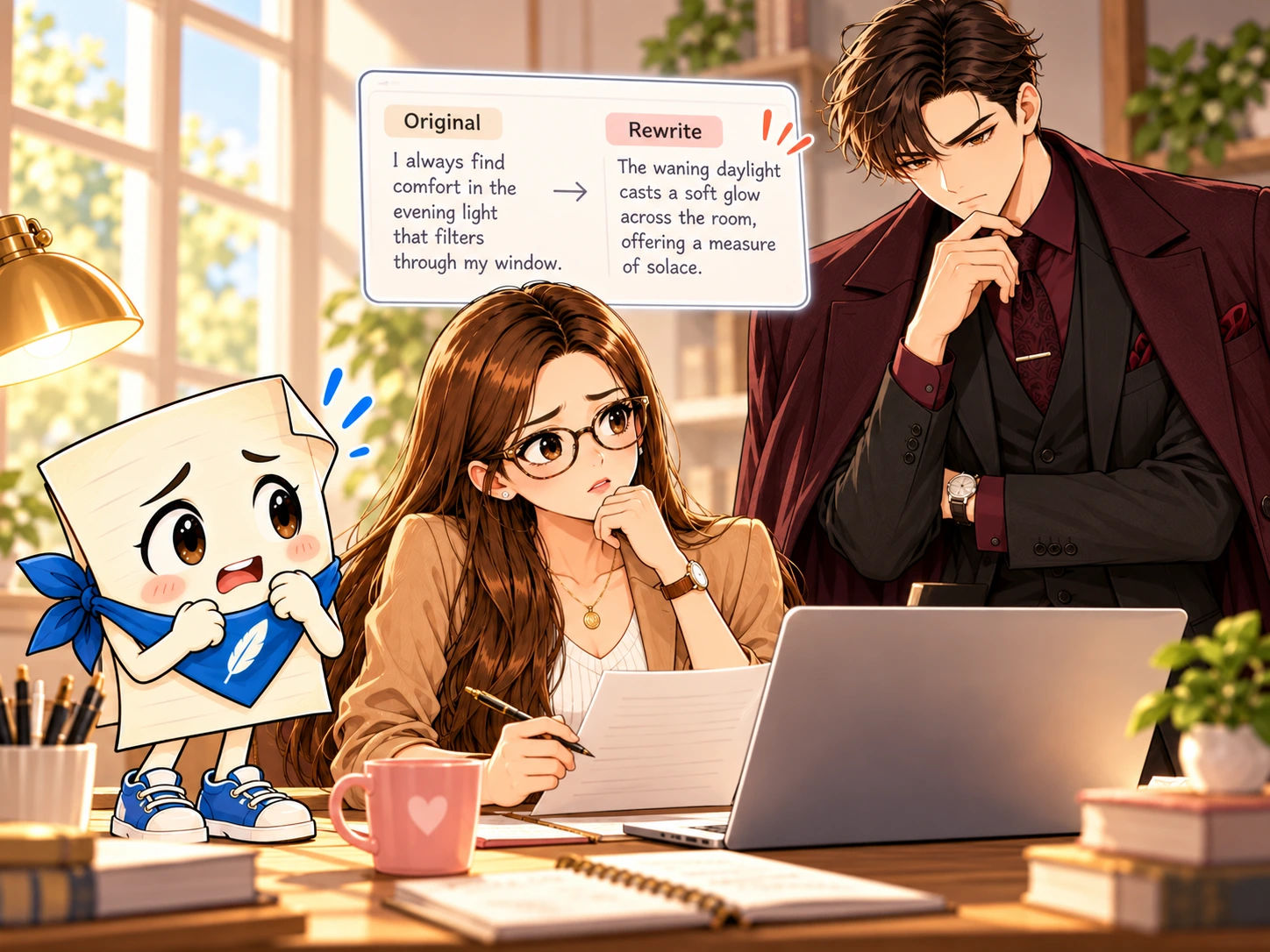
The original said:
They started with one laptop, one dining table, and more ideas than clients.
The rewrite said:
The studio was established with a clear creative vision and a commitment to delivering thoughtful work for a growing client base.
Patricia stared at the two versions.
The second sounded more professional.
It also sounded like it could belong to almost any company.
Still, she copied it into the draft.
“Just for now,” she said.
Draft did not answer.
More Polished
Patricia continued.
Whenever a sentence felt simple, she rewrote it.
Whenever a phrase sounded personal, she made it safer.
Whenever she saw humor, she asked whether it was professional enough.
The About page slowly changed.
The founders’ first chaotic project became an “early client engagement.”
Their habit of sketching ideas on receipts became “an iterative ideation process.”
Their proud sentence—
We make work we would be happy to put our names on.
—became:
We are committed to maintaining a high standard of creative excellence across every engagement.
Patricia leaned back.
The page was polished.
Very polished.
Mr. Red Pen would probably have admired it.
But he was not there.
Draft was.
And Draft had become unusually quiet.
“What?”
Draft pointed toward the screen.
“Read the first three paragraphs aloud.”
Patricia did.
Halfway through the second paragraph, she slowed down.
By the third, she was frowning.
“Why does this sound like a brochure for a bank?”
Draft gave a small shrug.
“You asked for polished.”
“I did not ask for this.”
A notification appeared.
The client wanted to review the draft on a call that afternoon.
Patricia looked at the clock.
She had less than an hour.
Instead of restoring the original, she tried another rewrite.
Warmer, but still professional.
Then:
More natural.
Then:
More confident.
Then:
Make it sound like an experienced native English copywriter.
Draft’s eyes widened.
Patricia noticed.
“What?”
“Nothing.”
“That was absolutely something.”
Draft looked at the screen.
“You already wrote a version you liked.”
“I need it to sound professional.”
“It did.”
Patricia ignored him and accepted another rewrite.
Something moved across the document.
At first it looked like a cursor.
Then the letters in one sentence trembled.
A thin, dark ribbon slipped between them.
Patricia stopped typing.
The ribbon curled around one line of text.
When it pulled away, the sentence underneath remained correct.
But something about it felt flatter.
Draft stood.
“Oh no.”
The ribbon rose from the screen.
Two long arms appeared.
Then a small creature unfolded itself from the shadow.
It wore a mask made from scraps of different writing styles.
One side looked formal.
One side cheerful.
One side academic.
One side strangely robotic.
Its body was wrapped in loose strips of stolen sentences.
Patricia stared.
“What is that?”
Draft’s expression turned serious.
“Voice Snatcher.”
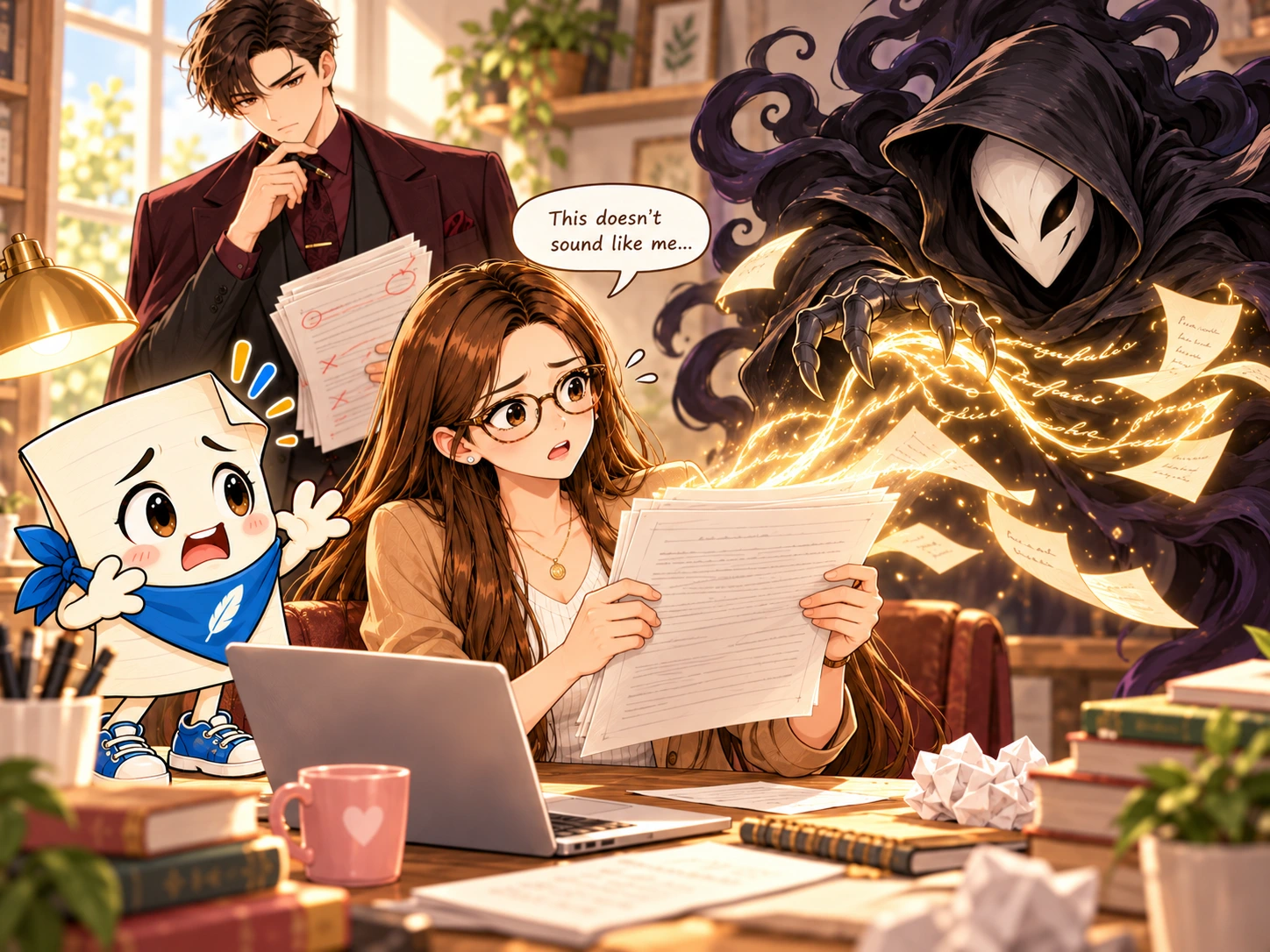
Voice Snatcher
Voice Snatcher did not care whether writing was correct.
It preferred writing that had already been corrected.
Its favorite moment came afterward.
When the writer stopped trusting their own choices.
It moved across Patricia’s draft.
Every time it touched a sentence, the sentence became smoother.
Safer.
More generic.
The creature pulled out tiny glowing fragments.
A joke.
A short sentence.
An unusual rhythm.
A specific memory.
It tucked each fragment inside its coat.
Patricia stood.
“Give those back.”
Voice Snatcher tilted its masked head.
Then it copied Patricia’s voice perfectly.
“Make this more professional.”
Patricia froze.
Draft looked at her.
The creature copied her again.
“Make this sound more native.”
Then:
“Make this better.”
Each phrase came out in Patricia’s own voice.
That made it worse.
The Client Call
The client appeared on Patricia’s screen twenty minutes later.
Patricia shared the draft.
She expected approval.
Instead, the client became quiet after the first page.
Patricia’s stomach tightened.
“Is something wrong?”
The client hesitated.
“It is well written.”
Patricia waited.
“But?”
“It does not really sound like us.”
Patricia looked at the draft.
The client continued.
“The first version you sent in the outline had more personality. It felt closer to how we actually talk.”
Patricia swallowed.
“I can revise it.”
“We do want it polished,” the client said. “We just do not want to sound like every other studio.”
After the call ended, Patricia stared at the screen.
Draft said nothing.
Voice Snatcher sat on top of the document, swinging its feet.
Patricia pointed at it.
“This is your fault.”
Voice Snatcher held up one stolen sentence.
Draft crossed his arms.
“Only partly.”
Patricia looked at him.
“You are supposed to be on my side.”
“I am.”
“That sounded like Scribe.”
“That is unfortunate.”
Patricia laughed despite herself.
Then she became serious again.
“I kept thinking professional meant less like me.”
Draft nodded.
“And less like the client.”
Patricia opened the version history.
There were dozens of changes.
Some were useful.
Some fixed real problems.
Others only replaced specific language with generic language.
She needed a way to tell the difference.

Scribe’s Surprise
Patricia sent Scribe two short paragraphs.
The original.
The heavily rewritten version.
She expected him to prefer the polished one.
His reply arrived ten minutes later.
First version.
Patricia stared at the message.
She typed:
Really?
Scribe replied:
The second is cleaner.
Patricia waited.
Then another message appeared.
It is also forgettable.
Patricia laughed.
Draft leaned over the keyboard.
“I would like this moment recorded.”
Patricia typed:
You are telling me not to rewrite something?
Scribe:
Do not become dramatic.
A few seconds later:
I am telling you that editing has a purpose. If the first version is clear and the voice fits the client, replacing it with generic phrasing does not improve it.
Patricia read the message again.
Scribe continued:
There are two weak sentences in the original. Fix those.
Leave the rest alone.
Patricia smiled.
“Who are you and what have you done with Scribe?”
Draft pointed toward the screen.
“He is still Scribe. He found two weak sentences.”
The Keep My Voice Review
Patricia opened DeskDraft and switched on Keep My Voice.
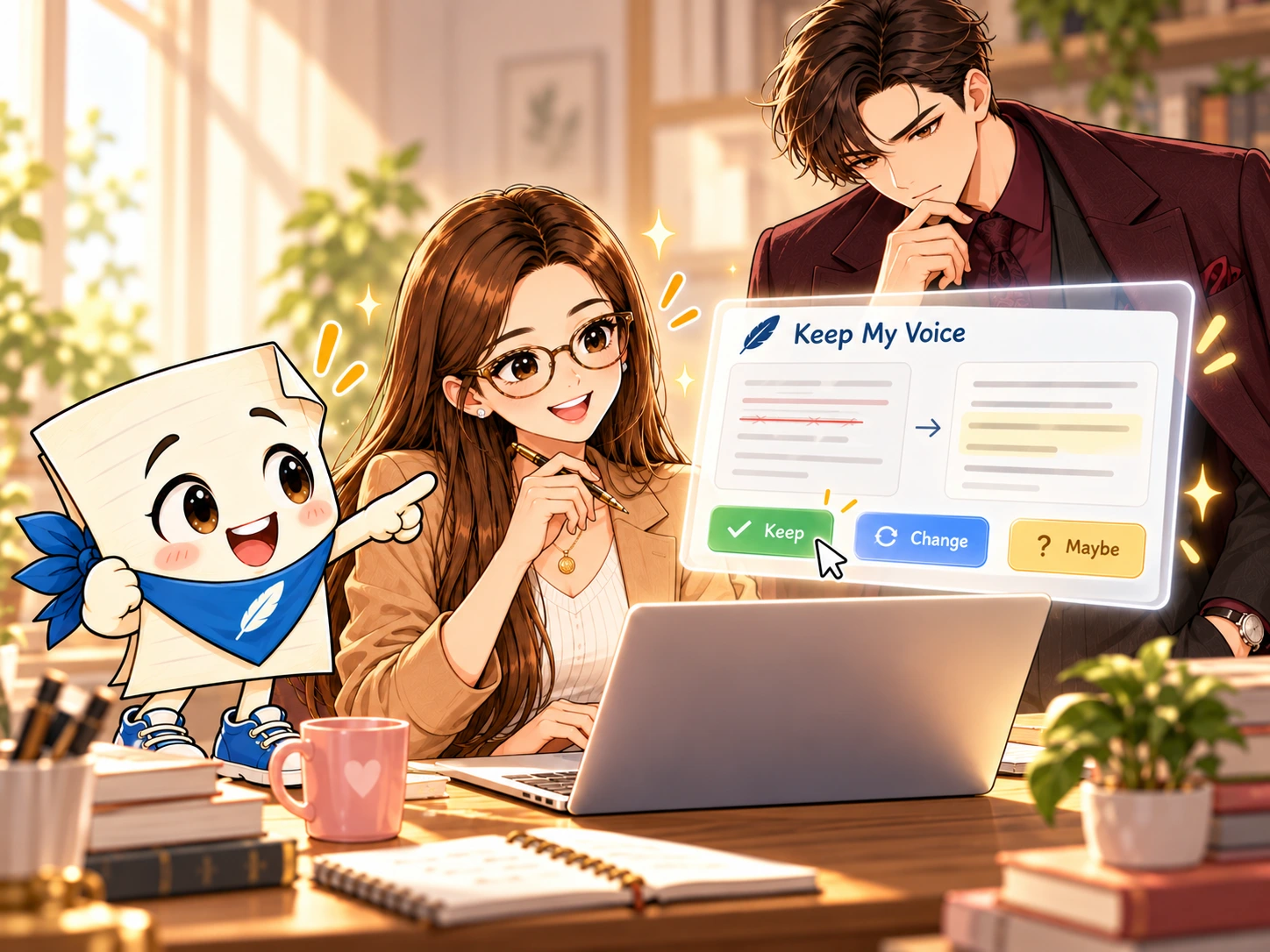
She placed the original draft beside the rewritten version.
The review did not tell her to keep everything she had written.
Instead, it separated the changes.
Clarity improvement.
Grammar correction.
Better structure.
Tone adjustment.
Style preference.
Possible voice change.
Patricia clicked one sentence.
Original:
They started with one laptop, one dining table, and more ideas than clients.
Rewritten:
The studio was established with a clear creative vision and a commitment to delivering thoughtful work for a growing client base.
DeskDraft marked the rewrite:
Meaning preserved, but personal detail and original voice reduced.
Patricia nodded.
“Exactly.”
She restored the original.
Voice Snatcher hissed.
One glowing fragment escaped from its coat and flew back into the sentence.
Patricia reviewed another change.
Original:
Their first client came from a friend who needed a logo by Friday.
Rewritten:
Their initial client opportunity emerged through a referral requiring a rapid branding deliverable.
Patricia laughed.
“No one talks like that.”
Draft smiled.
She restored the original, then adjusted it herself:
Their first client came through a friend who needed a logo by Friday.
Clearer.
Still natural.
Another fragment returned.
The creature became smaller.
Not Everything Comes Back
Patricia reached a paragraph that genuinely had problems.
The original repeated the same idea three times.
She had also buried the main point at the end.
The AI rewrite was better structured.
Patricia looked at Draft.
“So I keep this one?”
“Do you understand why it is better?”
“Yes.”
“Then you are choosing the edit. The edit is not choosing for you.”
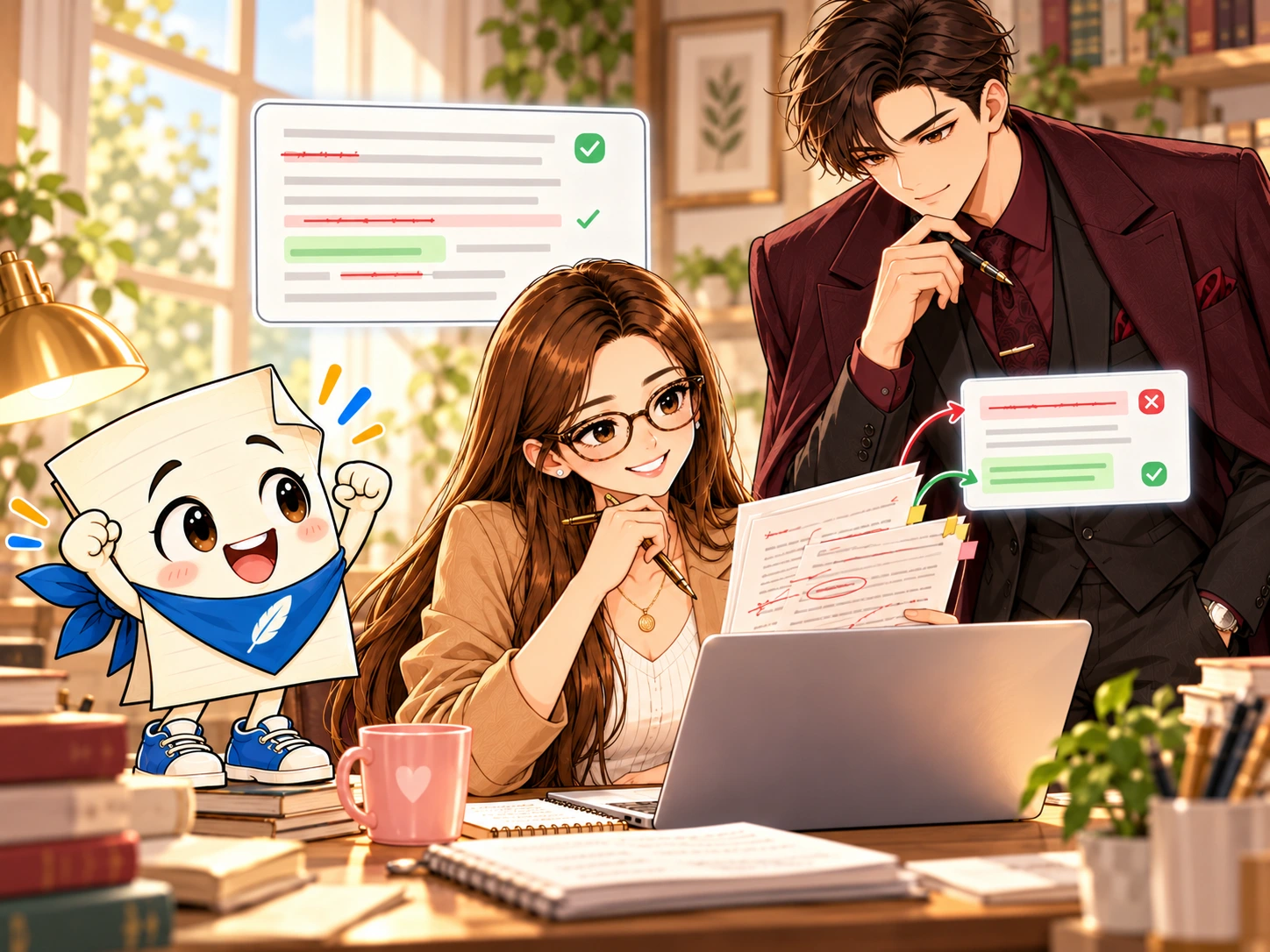
Patricia kept the structure.
But she rewrote two lines in her own words.
Voice Snatcher lost another piece of its coat.
Patricia continued.
She accepted grammar fixes.
She kept a stronger transition.
She restored a joke the client had liked.
She removed a formal phrase that sounded impressive but meant very little.
She shortened two paragraphs.
She kept one of Scribe’s suggested changes.
Then she rejected another.
By the end, the draft was cleaner than the first version.
But when Patricia read it aloud, she recognized the rhythm again.
She could imagine the founders saying the words.
That was the test.
Draftspace
The room dissolved.
Patricia stood in Draftspace between two enormous versions of the About page.
On the left, the first draft glowed with warm light.
It was uneven in places.
Some sentences were too long.
But little details lived inside it.
The dining table.
The Friday deadline.
The sketches on receipts.
On the right, the heavily rewritten draft shone with cold white light.
It was polished.
Perfectly aligned.
Almost nothing was wrong.
Almost nothing was memorable.
Voice Snatcher stood between the two pages.
Its coat was full of stolen fragments.
Draft pointed toward the left page.
“Editing should help this version become clearer.”
Then toward the right.
“It should not require turning it into that version.”
Patricia looked at the two pages.
“So Keep My Voice does not mean refusing edits.”
“No.”
“It means knowing what is mine and what is actually a problem.”
Draft smiled.
“Yes.”
Patricia stepped toward Voice Snatcher.
The creature raised its mask.
Patricia held out her hand.
“I want the details back.”
One by one, the stolen fragments floated from its coat.
The dining table.
The logo by Friday.
A line of humor.
A short sentence Patricia had almost deleted because it felt too simple.
The fragments returned to the page.
Voice Snatcher shrank until it was barely taller than Draft’s shoe.
It folded its arms.
Patricia smiled.
“You can stay.”
Draft looked surprised.
Patricia continued.
“You remind me to check whether I am editing for a reason.”
Voice Snatcher considered this.
Then it climbed onto the edge of the page.
The Final Draft
Patricia sent the revised About page to the client.
The reply came that evening.
This is it.
It feels polished, but it still sounds like us.
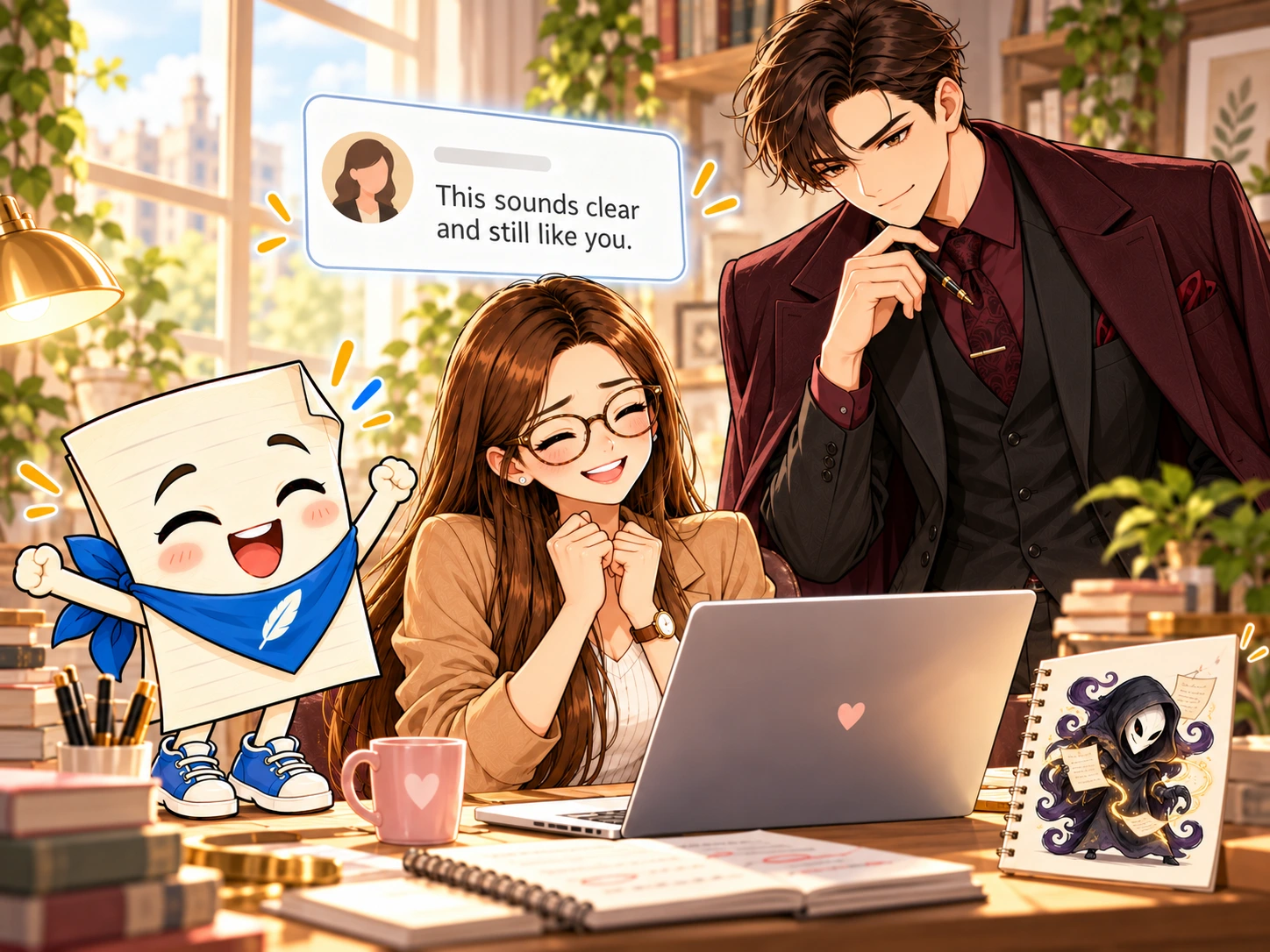
Patricia smiled at the screen.
That sentence mattered more than “looks professional.”
She opened her Draftling notebook.
Draftling #004 - Voice Snatcher
Represents: Losing the writer’s personal voice through unnecessary rewriting.
Weakness: Ask what each edit improves. Keep changes that solve a real problem. Question changes that only make the writing sound like someone else.
DeskDraft Feature: Keep My Voice.
She added:
Professional does not mean generic.
Then another line:
A stronger version of your writing should still feel like your writing.
Draft read it.
“Good.”
Patricia looked at him.
“No correction?”
“I am learning from Mr. Red Pen.”
“That is worrying.”
From the corner of the desk, Voice Snatcher copied her voice perfectly.
“That is worrying.”
Patricia stared at it.
Draft laughed.
The creature smiled behind its mask.
Patricia turned back to the final draft.
It was cleaner.
Stronger.
More confident.
And this time, when she read it, she did not wonder who had written it.
She knew.